

Blogs
China IP Law Update
Apple Defeats $1.5 Billion Patent Infringement Claim Over Siri in Shanghai High People’s Court
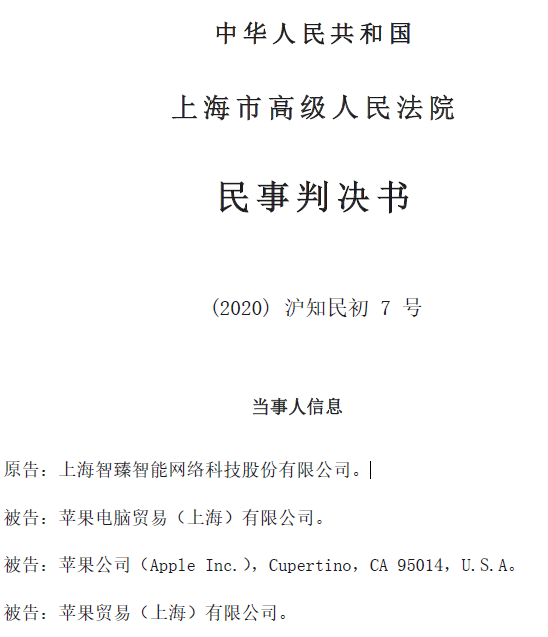
The Shanghai High People’s Court has ruled against Shanghai Xiaoi Robot Technology Co., Ltd. (上海智臻智能网络科技股份有限公司) in a patent infringement action targeting three Apple entities, ending a dispute over whether Apple’s Siri voice assistant infringed a Chinese “chatbot system” patent. The judgment in Case No. (2020) 沪知民初7号 rejected all of Xiaoi’s claims, including a damages demand that, after adjustment, stood at approximately RMB 5.1 billion (on the order of USD 700 million based on the court’s own exchange-rate reference, though Xiaoi’s underlying infringement-profit theory reached RMB 64.3 billion). Xiaoi’s original pleading had sought RMB 10.1 billion.
Background
Xiaoi owns Chinese invention patent No. 200410053749.9, titled “A Chatbot System,” filed August 13, 2004, granted July 22, 2009, and expired at the end of its term on August 13, 2024. Xiaoi asserted claims 1 and 9 against a range of iPhone models from the iPhone 7 through the iPhone 14 series, all of which run Siri.
The dispute has an extended history. Xiaoi first sued Apple in 2012 over Siri on the iPhone 4S. Apple responded with an invalidation request, and the patent was ruled as invalid by the Beijing High People’s Court in 2015, which led the Shanghai No. 1 Intermediate People’s Court to dismiss the earlier infringement suit in 2016. In 2020, the Supreme People’s Court, on retrial, reversed the Beijing High People’s Court and upheld the validity of all claims. On that basis, Xiaoi filed the present action. During this litigation, Apple filed two further invalidation requests (in 2020 and 2021); both were rejected by the China National Intellectual Property Administration and upheld on subsequent administrative review, so the patent remained valid throughout the proceedings.
The Asserted Claims
Claim 1 recites a chatbot system comprising a user and a chatbot. The chatbot has an artificial intelligence server (and corresponding database) with AI and information-service functions, a communication module, and a configuration in which the user communicates with the chatbot through an instant messaging platform or SMS platform. The claim further requires that the chatbot have a query server (with database) and a game server, and that the chatbot include a filter that distinguishes whether a user statement received by the communication module is a “formatted statement” or “natural language,” then routes the statement to the corresponding server — the AI server, query server, or game server. Claim 9 is the corresponding method claim.
The Court’s Technical Investigation
Apple stated that it could not produce Siri’s source code or technical documentation for comparison, and the accused products could not be examined through disassembly or reverse engineering to reveal their internal processing. The court therefore conducted black-box testing — observing input and output behavior to infer the products’ likely technical implementation — on an iPhone 14 Pro (iOS 16.0.2) and an iPhone 12 Pro Max (iOS 14.3).
After the close of argument, Apple submitted confidential technical materials concerning Siri’s natural-language processing system, contending that Siri processes all user input through a single AI pathway and lacks any mechanism to route shortcuts to a query server or game server. The court found these materials, standing alone, insufficient to establish Apple’s asserted architecture because they did not show how shortcut input is handled and included no corresponding worked examples. The materials did, however, indicate a means of verification testing. Using Apple’s testing environment and tools (the AceUI software against Apple’s server), the court organized a verification test in December 2024. That test confirmed consistency with the black-box results for the inputs examined, but because of environmental limitations it could not test user-defined shortcuts or app shortcuts, and it could not confirm whether preset shortcuts pass through all steps of Siri’s processing.
Claim-by-Claim Analysis
The court found that the accused products met four of the six technical features of claim 1: the user-and-chatbot system (feature 1); an AI server with a corresponding database (feature 2); a communication module (feature 3); and a query server and game server with corresponding databases (feature 5). On feature 5, the court noted Siri’s ability to retrieve weather information through an app in response to formatted input, and its ability to run interactive games such as “knowledge trivia” and a “music quiz.”
The court found that two features were absent:
Feature 4 — communication through an instant messaging or SMS platform. The court reasoned that an instant messaging platform is one through which two or more parties transmit messages in real time over a network, generally with the parties positioned at two ends of a network. A user’s interaction with Siri through voice or text input is substantially the same as ordinary input of information; it represents a change in input method rather than communication through an instant messaging platform, and Siri and the user cannot be said to occupy two ends of a network. The products also do not communicate with the chatbot through an SMS platform. Feature 4 was therefore not met.
Feature 6 — the filter. Applying the Supreme People’s Court’s construction (from (2024) 最高法知行终854号) that a “formatted statement” is “a combination of commands and parameters having a system-preset fixed format or structure, capable of being quickly and accurately recognized by a computer and triggering execution of a specific command or operation,” the court examined Siri’s shortcut-recognition mechanism. Siri’s shortcuts fall into three categories — user-defined shortcuts, app shortcuts, and preset shortcuts. The court found that user-defined and app shortcuts are set by users or developers rather than being system-preset fixed-format command-and-parameter combinations, and so are not “formatted statements.” For preset shortcuts, black-box testing could not determine whether they are routed to the AI server, the query server, or the game server. Following the Supreme People’s Court’s construction (from (2017) 最高法行再34号) that the filter routes formatted statements to the query or game server and natural-language statements to the AI server, the court concluded that it could not find Siri to have a filter that routes formatted statements to a query server or game server. Feature 6 was therefore not met.
Because the accused products lacked features 4 and 6 of claim 1 — and because Siri’s shortcut-recognition mechanism was neither identical nor equivalent to the claimed filter — the products did not fall within the scope of claim 1. The court reached the same conclusion for method claim 9 on the same grounds.
Outcome
Having found no infringement of claim 1 or claim 9, the court did not address Apple’s prior art defenses (based on the “SmarterChild” system and the “Catacomb” project), the disputed injunction question, or the damages calculation. The court dismissed all of Xiaoi’s claims and assessed the case acceptance fee of RMB 25,550,900 against Xiaoi.
The Parallel Declaratory Judgment Action
The infringement suit was decided alongside a companion declaratory judgment action, Case No. (2022) 沪知民初3号, in which Apple Computer Trading (Shanghai) and Apple Trading (Shanghai) were the plaintiffs and Xiaoi the defendant. That action sought a declaration that Siri on the iPhone SE (3rd generation), iPhone 12 series, and iPhone 13 series does not infringe the same patent. It was tried by the same panel on the same evidentiary record, using the same black-box and verification testing. Applying the identical claim construction and reaching the identical technical conclusions — no instant messaging platform and no qualifying filter — the court granted Apple’s request and declared the specified products non-infringing, while denying Apple’s request for reimbursement of RMB 2 million in expenses as lacking a legal basis in a declaratory action. Together, the two judgments resolve the infringement question consistently across the overlapping product ranges: no infringement in either case.
Copies of the judgements are available from Michael Ma‘s substack here.
Original article can be found here: Read more