

Blogs
China IP Law Update
Chinese Supreme People’s Court Ruling Underscores the Role of Contemporaneous Technical Records in Determining Where an Invention Was Completed for Foreign-Filing Security Review Purposes
In a decision published July 13, 2026, the IP Tribunal of the Supreme People’s Court of China has issued a final ruling in (2022) 最高法知行终255号, upholding the validity of a diagnostic device patent owned by EDAN Diagnostics, Inc. against an invalidation challenge brought by Guangzhou Wan XX Biotechnology Co., Ltd. The decision offers guidance on how Chinese courts determine whether an invention’s “substantive content” was completed in China for purposes of the foreign-filing security review requirement under Article 20 of the Chinese Patent Law.
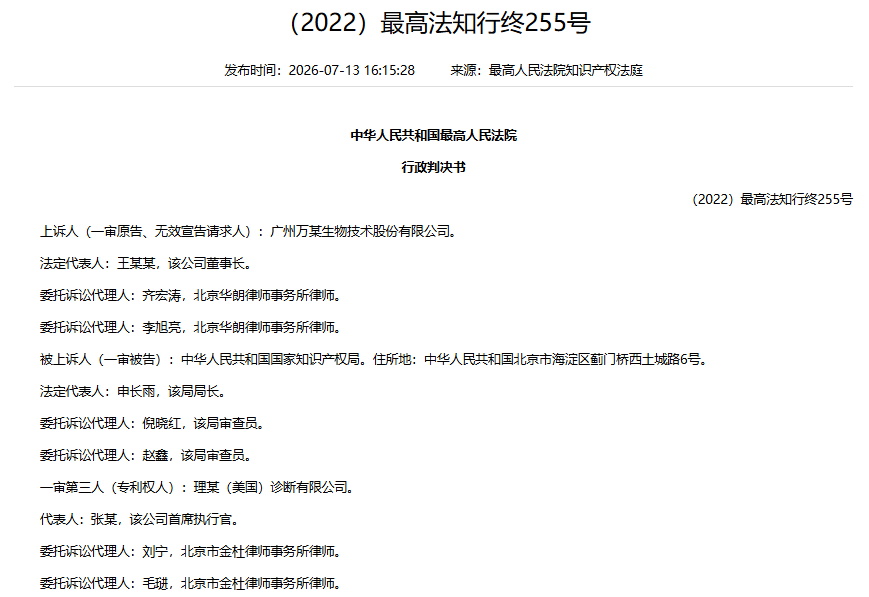
EDAN Diagnostics, Inc. holds Chinese Patent No. 201310322059.8, titled “An In Vitro Medical Diagnostic Device and System.” The patent, granted in October 2015, claims priority to a US patent application filed December 6, 2012, and was itself filed in China on July 29, 2013.
Wan XX filed a petition with the China National Intellectual Property Administration (CNIPA) seeking to invalidate the patent, arguing that EDAN Diagnostics had violated Article 20, paragraphs 1 and 4, of the Patent Law. Under that provision, any invention “completed in China” must undergo a confidentiality/security review before being filed abroad (analogous to the USPTO foreign filing license requirement); failure to do so bars the grant of a corresponding Chinese patent for the same invention. Wan XX contended that the invention was actually developed in China – specifically, as an output of a Guangdong provincial government-funded R&D project carried out by a related Shenzhen-based EDAN entity – and that EDAN Diagnostics improperly filed first in the United States without the required review.
CNIPA rejected the invalidation petition, finding insufficient evidence that the invention was completed in China. The Beijing IP Court affirmed at first instance, and Wan XX appealed to the Supreme People’s Court.
The Tribunal’s analysis turned on two sequential questions: what constitutes the “substantive content” of the claimed invention, and whether that substantive content was actually completed within China’s territory.
On the first question, the court held that the relevant benchmark for identifying substantive content is a comparison against the closest prior art – which may be drawn from the inventor’s own testimony where that testimony identifies prior art more pertinent than the generalized background section of the patent specification. Here, the first-named inventor testified that the invention’s three core advances over Abbott’s existing point-of-care testing device were: separation of the test card from the reagent pack (rather than a combined, single-use unit); elimination of internal fluid pathways within the diagnostic instrument itself; and automatic (rather than manual) sample loading. The Tribunal agreed that these three points – not the broader claim language, and not the limitations recited in dependent claims – defined the substantive content of the invention for security-review purposes. It specifically rejected Wan XX’s argument that additional dependent-claim features should also be treated as substantive content, finding no evidentiary basis that those features reflected independent inventive contributions beyond routine structural/functional refinement.
Applying that framework to the second question, the Tribunal weighed several categories of evidence. EDAN Diagnostics submitted email exchanges among the three named inventors from January through June 2010, in which they discussed and refined the test-card fluid channel design, the T-connector and reagent-pack fluid path, valve and heater specifications, and the mechanism for using a vacuum pump to achieve automatic sample loading. The court found these emails – when cross-checked against each other for internal consistency of technical detail, such as matching discussion of specific heater model numbers – demonstrated that all three claimed inventive points had been substantially worked out by June 2010.
Wan XX argued that certain forwarded emails, obtained from one inventor’s mailbox years after the fact in 2018, could have been edited and should be disregarded. The Tribunal upheld the lower court’s finding of authenticity, citing the absence of visible alteration, the logical and chronological coherence of the correspondence, and corroboration between the challenged emails and other emails whose authenticity was unchallenged.
Passport records showed that none of the three named inventors had a substantial presence in China during the critical January–June 2010 period; one inventor spent only 58 days in China during that window, a second was not in China at all, and there was no evidence the third had ever entered China before the relevant date. This supported the conclusion that the development work occurred in the United States.
The court also considered the general trajectory of medical device R&D, noting that concept-to-market timelines in this field typically span multiple years, and that maintaining early-stage technical concepts as trade secrets before filing a patent application is a recognized industry practice for extending the pre-disclosure protection period. On this basis, the Tribunal characterized the Guangdong-funded project, which began in January 2011 after the inventors’ email exchanges, as a later-stage commercialization and industrialization effort built on an already-completed technical concept, rather than the original research that produced the inventive content.
Wan XX also argued that a related Shenzhen entity had, in a separate infringement lawsuit, made statements characterizing a companion patent as an output of the same government-funded project, and that this constituted a binding admission attributable to EDAN Diagnostics. The Tribunal rejected this argument, noting that the Shenzhen entity was not the patentee of the patent at issue, and that its statements in the other proceeding did not address where the substantive content of the invention at issue had been completed.
The Supreme People’s Court IP Tribunal dismissed the appeal in full, holding that EDAN Diagnostics’ evidence sufficiently established that the substantive content of the claimed invention was completed in the United States, not in China. Because the invention was not “completed in China” within the meaning of Article 20, the security review requirement never applied, and there was no basis to invalidate the corresponding Chinese patent. The first-instance judgment was affirmed, and the ruling is final.
The decision reinforces several points of practical significance for patent owners and challengers operating across US–China R&D pipelines:
- Inventor testimony can define the comparative baseline. Where a patent specification’s background-art discussion is generic, an inventor’s own characterization of the closest prior art, and the resulting inventive points, may control the “substantive content” analysis for foreign-filing security review purposes, rather than a claim-by-claim parsing of every limitation.
- Contemporaneous technical correspondence is evidence of completion date and location. Detailed, cross-corroborated emails discussing specific engineering choices, such as component models and design iterations, can establish when an invention was substantively finalized and, combined with other evidence, where that work occurred.
- Travel records corroborate where inventive work was performed. Passport and entry/exit records showing the inventors’ physical presence — or absence — during the period when the substantive content was developed can be determinative on the question of the completion location, particularly when read together with dated technical correspondence.
- Later-stage government-funded commercialization projects do not necessarily establish “completion in China.” A project report describing production, testing, or industrialization activity, even one that references related foreign patent filings as project outputs, does not by itself demonstrate that the underlying inventive concept was originated or completed within the funding jurisdiction.
- Admissions by affiliated but distinct legal entities require careful scrutiny. Statements made by a related company in unrelated litigation, concerning a different patent, will not readily be imputed to the patentee for purposes of establishing where an invention was completed.
The full decision is available here (Chinese only). The SPC’s social media posting highlighting the decision is available here (Chinese only).
Original article can be found here: Read more