

Blogs
China IP Law Update
China’s Trademark Law Overhauled: Key Changes Taking Effect January 1, 2027
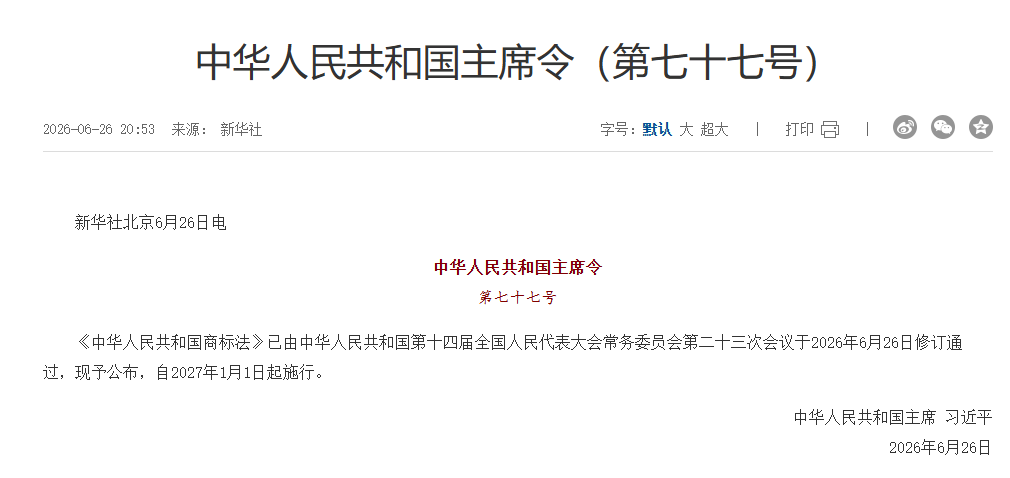
On June 26, 2026, the Standing Committee of the National People’s Congress adopted a comprehensive revision of the Chinese Trademark Law. The revised law takes effect on January 1, 2027 and introduces a range of substantive and procedural changes that will affect trademark owners, licensees, and practitioners operating in China. This article addresses ten changes of particular note.
 1. Dynamic Marks Now Registrable
The revised law expands the categories of registrable signs to include dynamic marks (动态标志). Article 14 now lists dynamic marks alongside text, figures, letters, numbers, three-dimensional marks, color combinations, and sound marks as signs that may be registered as trademarks. This addition reflects the growing commercial use of animated logos, motion graphics, and other time-based brand identifiers in digital environments. Applicants seeking to register dynamic marks should be aware that Article 18 simultaneously imposes a functionality exclusion: dynamic effects that arise from the nature of the goods themselves, are necessary to achieve a technical result, or give substantial value to the goods are not registrable. This mirrors the functionality doctrine already applicable to three-dimensional marks and extends it expressly to the new dynamic mark category.
2. Internet Use Expressly Included in the Definition of Trademark Use
Under the 2019 law, trademark use was defined as affixing a mark to goods, packaging, containers, or transaction documents, or using a mark in advertising, exhibitions, or other commercial activities, for the purpose of identifying the source of goods. The revised law retains this definition but adds a new paragraph to Article 2 stating that trademark use includes use conducted “through the internet and other information networks” (通过互联网等信息网络实施的使用行为). This express inclusion of online use has practical significance in several contexts: it clarifies that use on e-commerce platforms, social media, and other digital channels counts toward satisfying use requirements for purposes of resisting non-use cancellation proceedings; it also means that online infringing activity falls squarely within the scope of acts that can constitute trademark infringement and trigger administrative enforcement.
3. Good Faith Principle Expanded
The 2019 law stated that trademark registration and use should follow the principle of good faith (诚实信用原则) in a single sentence. The revised Article 9 retains this obligation and adds an express prohibition on “abusing rights to harm national interests, public interests, or the legitimate rights and interests of others” (不得滥用权利损害国家利益、社会公共利益或者他人合法权益). This anti-abuse formulation gives enforcement authorities and courts a broader textual basis to address conduct that, while not clearly falling within enumerated bad faith filing categories, involves the exercise of trademark rights in a manner that causes harm to third parties or the public. Read together with the new bad faith filing penalty provisions discussed below, the expanded good faith principle signals a legislative intent to address opportunistic trademark behavior across the full lifecycle of a mark, from application through enforcement.
4. Functional Exclusions Extended to All Non-Traditional Marks
The 2019 law applied the functionality doctrine only to three-dimensional marks: shapes arising from the nature of the goods, shapes necessary to achieve a technical result, and shapes that give substantial value to the goods were excluded from registration. The revised Article 18 extends this exclusion to color combinations, sound marks, and dynamic marks in addition to three-dimensional marks. Correspondingly, Article 73 now provides that a registered trademark owner has no right to prohibit others from making legitimate use of functional features in any of these non-traditional mark categories. For brand owners, this means that registrations covering non-traditional marks will be subject to challenge on functionality grounds that were previously available only against three-dimensional marks. Applicants should ensure that the distinctive elements of a non-traditional mark are separable from any functional attributes of the mark before filing.
5. Opposition Period Shortened from Three Months to Two Months
Under the 2019 law, any person could oppose a preliminarily approved trademark within three months of the publication date. The revised Article 36 shortens this window to two months. For trademark owners monitoring third-party applications, this change requires more active and timely watching programs. Opposers who identify a conflicting application will have one month less to gather evidence, prepare submissions, and file. The change also affects the date from which trademark rights are calculated following a successful defense against an opposition: under the revised law, rights are calculated from the date two months after the preliminary announcement (rather than three months), consistent with the shortened opposition period.
6. Post-Cancellation Filing Bar for Voluntary Cancellations
The revised Article 49 introduces a one-year filing bar following voluntary cancellation of a registered trademark. Within one year of the announcement of a voluntary cancellation, the State Council trademark authority will not approve third-party applications for identical or similar marks on the same or similar goods. The 2019 law contained a one-year bar applicable to marks that were cancelled, invalidated, or expired without renewal, but the application of that bar to voluntary cancellations was less clearly addressed. The new provision closes a potential gap that could otherwise be exploited through strategic voluntary cancellation followed by immediate re-filing, whether by the original registrant or a third party. Trademark owners considering voluntary cancellation of marks they may wish to re-register should factor this one-year waiting period into their planning.
7. Expanded Bad Faith Filing Penalties Targeting Applicants Directly
The 2019 law addressed bad faith trademark registration primarily through refusal provisions and through penalties directed at trademark agencies that accepted bad faith instructions. The revised Article 54 creates a standalone administrative penalty provision targeting trademark applicants themselves. Where an applicant commits bad faith registration acts that cause adverse effects, the trademark enforcement authority may issue a warning and impose a fine of up to RMB 100,000. The enumerated bad faith acts include: knowingly applying for marks that violate the CCP symbol prohibition or the geographic name prohibition; filing applications that are not for the purpose of use and obviously exceed normal business needs; and intentionally filing in violation of the well-known mark protection provisions, the agent/representative prohibition, the prior user rights provision, or the prior rights prohibition. This provision fills a gap in the prior enforcement framework by creating direct administrative accountability for applicants, not merely their agents. Combined with the expanded good faith principle in Article 9, it provides enforcement authorities with tools to address systematic bad faith filing activity.
8. Overseas Trademark Matters
Article 69 is new in the revised law and addresses two distinct situations involving trademark activity outside China’s borders. First, where confirmation of a trademark’s well-known status in China is needed in the course of overseas trademark examination or case proceedings, the National Intellectual Property Administration may, upon request, make a formal confirmation of well-known status in accordance with the recognition factors set out in Article 63. This provides a mechanism for Chinese trademark owners to obtain official documentation of well-known status for use in foreign proceedings. Second, where a trademark agent handles overseas trademark registration or other trademark matters for a Chinese client using fraud or other improper means, causing harm to the client’s interests or to national interests, public interests, or the legitimate rights of others, the agency misconduct penalty provisions apply. This extension of Chinese administrative penalties to overseas agency conduct is notable for agents handling international filing work on behalf of Chinese clients.
9. Statutory Damages Cap Retained at RMB 5,000,000
The revised Article 77 retains the statutory damages cap of RMB 5,000,000 (approximately USD 690,000 at current exchange rates) for cases where actual losses, infringer’s profits, and license fee multiples are all difficult to determine. The punitive damages multiplier of one to five times the base amount for willful infringement with serious circumstances is also retained. One structural change in the damages framework is that the revised law treats actual losses and infringer’s profits as co-equal primary measures, rather than listing them sequentially as in the 2019 version. The revised law also retains the provision allowing courts to order infringers to produce relevant accounts and records where the rights holder has made reasonable efforts to present evidence, and to draw adverse inferences from non-production or falsification of such records. Rights holders should note that the revised Article 78 clarifies the non-use defense: a defendant may raise the rights holder’s failure to use the mark as a defense to a damages claim, and the relevant three-year use period is now expressly anchored to the period before the infringing act occurred, rather than simply “the preceding three years.”
10. New Abusive Litigation Sanction Provision
Article 81 is new in the revised law and addresses the use of trademark litigation as a tool for harassment or anticompetitive conduct. Where a party brings trademark litigation through malicious collusion with another party, or through unilateral fabrication of the basic facts of a case, the court may impose sanctions under the applicable procedural rules. Where such conduct causes loss to the opposing party, the party responsible is liable for civil damages. This provision is directed at a recognized problem in Chinese trademark practice: the filing of baseless or manufactured infringement claims as a means of disrupting competitors or extracting settlements. The provision does not define the precise threshold for “malicious collusion” or “fabrication of basic facts,” and courts will need to develop standards through case law. Parties defending against trademark claims they believe to be abusive should document the circumstances of the litigation and consider seeking sanctions under this provision where the facts support it.
The full text of the amended 2026 Trademark Law is available here (Chinese only).
Original article can be found here: Read more