

Blogs
CNIPA Releases Draft Amendment to the Regulations on the Protection of Integrated Circuit Layout Designs for Comment
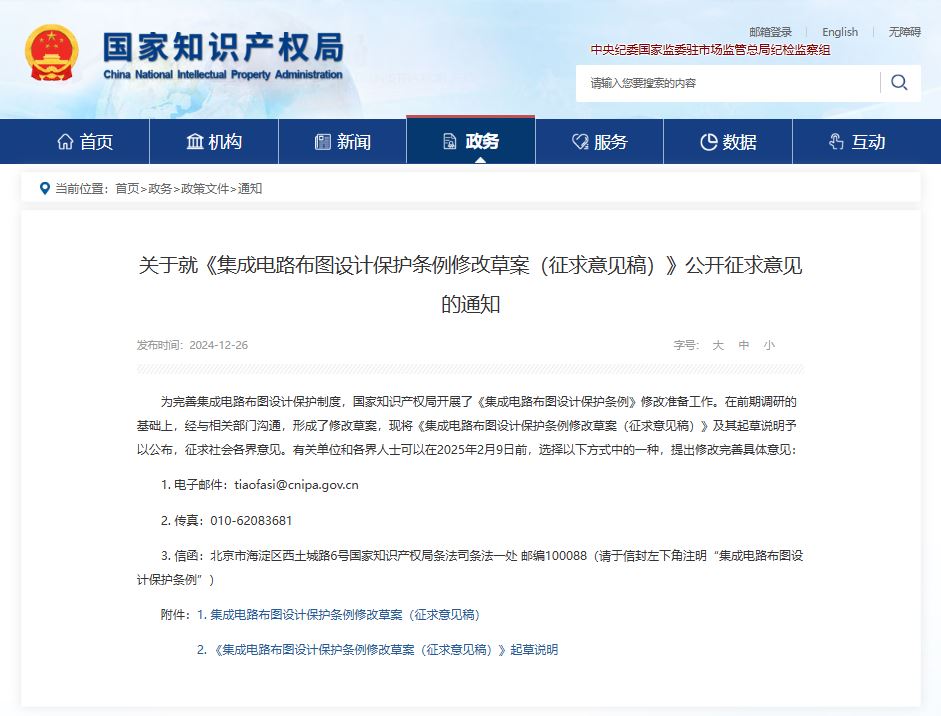
On December 26, 2024, China’s National Intellectual Property Administration (CNIPA) released the Draft Amendment to the Regulations on the Protection of Integrated Circuit (IC) Layout Designs for comment (集成电路布图设计保护条例修改草案(征求意见稿)). IC Layout Designs are somewhat analogous to design patents or copyrights but specifically for ICs and are not examined substantively. Some highlights of the Draft include:
- Foreigners must use a Chinese patent agency (Article 5)
- Good faith requirement (Article 9)
- Restoration of rights (Article 11)
- Remuneration for creators required (Article 17)
- Declaration of Originality identifying original parts of the design required (Articles 24, 26)
- Third parties may request reexamination of circuit layout designs (Article 32)
- Introduces damage calculations including punitive damages and a cap of 5 million RMB for statutory damages (Article 46)
- Evidence preservation is available (Article 47)
The original text is available here (Chinese only). Comments are due February 9, 2025. A machine translation of a comparison chart between current and draft amendments of the Regulations from 知识产权那点事 follows:
|
Current Regulations |
Draft for revision (draft for soliciting opinions) |
|
Regulations on the Protection of Integrated Circuit Layout Designs |
|
|
Chapter I General Provisions |
|
|
Article 1 These Regulations are formulated in order to protect the exclusive right to integrated circuit layout designs, encourage innovation in integrated circuit technology, and promote the development of science and technology. |
Article 1 These Regulations are formulated for the purpose of protecting the exclusive rights in integrated circuit layout designs, promoting the application of integrated circuit layout designs, encouraging innovation in integrated circuit technology, and promoting the development of science and technology. |
|
Article 2: We must uphold the leadership of the Communist Party of China in the work related to the exclusive rights to integrated circuit layout designs, improve the level of creation, application, protection, management and services for integrated circuit layout designs in our country, support all-round innovation and promote the construction of an innovative nation. |
|
|
Article 2 The following terms in these Regulations have the following meanings: (1) Integrated circuit means a semiconductor integrated circuit, that is, an intermediate product or final product that uses semiconductor material as a substrate, integrates two or more components, at least one of which is an active component, and part or all of the interconnection circuits in or on the substrate to perform a certain electronic function; (2) integrated circuit layout design (hereinafter referred to as layout design) means the three-dimensional arrangement of two or more components, at least one of which is an active component, and part or all of the interconnecting circuits in an integrated circuit, or such three-dimensional arrangement prepared for the manufacture of an integrated circuit; (3) Layout-design right holder refers to the natural person, legal person or other organization that enjoys the exclusive right to the layout-design in accordance with the provisions of these Regulations; (iv) reproduction means the act of repeatedly producing a layout-design or an integrated circuit incorporating such a layout-design; (5) Commercial utilization means the act of importing, selling or otherwise providing a protected layout-design, an integrated circuit incorporating such a layout-design, or an article incorporating such an integrated circuit for commercial purposes. |
Article 3 The following terms in these Regulations have the following meanings: (1) Integrated circuit means a semiconductor integrated circuit, that is, an intermediate product or final product that uses semiconductor material as a substrate, integrates two or more components, at least one of which is an active component, and part or all of the interconnection circuits in or on the substrate to perform a certain electronic function; (2) integrated circuit layout design (hereinafter referred to as layout design) means the three-dimensional arrangement of two or more components, at least one of which is an active component, and part or all of the interconnecting circuits in an integrated circuit, or such three-dimensional arrangement prepared for the manufacture of an integrated circuit; (3) Layout-design right holder refers to the natural person, legal person or unincorporated organization that enjoys the exclusive right to the layout-design in accordance with the provisions of these Regulations ; (iv) reproduction means the act of repeatedly producing a layout-design or an integrated circuit incorporating such a layout-design; (5) Commercial utilization means the act of importing, selling or otherwise providing a protected layout-design, an integrated circuit incorporating such a layout-design, or an article incorporating such an integrated circuit for commercial purposes. |
|
Article 3 Layout-designs created by Chinese natural persons, legal persons or other organizations shall enjoy the exclusive rights to layout-designs in accordance with these Regulations. If a layout-design created by a foreigner is first put to commercial use in China, he or she shall enjoy the exclusive right to the layout-design in accordance with these Regulations. For layout-designs created by foreigners, if their country has signed an agreement on layout-design protection with China or jointly participated in an international treaty on layout-design protection with China, the creators shall enjoy the exclusive right to the layout-design in accordance with these Regulations. |
Article 4 A layout-design created by a Chinese natural person, legal person or unincorporated organization shall enjoy the exclusive right to layout-design in accordance with these Regulations. Where a layout-design created by a foreigner , a foreign enterprise or other foreign organization is first put to commercial use in the territory of China, it shall enjoy the exclusive right to the layout-design in accordance with these Regulations. Layout-designs created by foreigners , foreign enterprises or other foreign organizations , if the country where the creators are from has signed an agreement on layout-design protection with China or has jointly participated in an international treaty on layout-design protection with China, shall enjoy exclusive rights to the layout-designs in accordance with these Regulations. |
|
Article 5 Foreigners, foreign enterprises or other foreign organizations that do not have a permanent residence or place of business in China and that apply for layout-design registration and handle other layout-design matters in China shall entrust a patent agency established in accordance with the law to handle the application. Chinese natural persons, legal persons or unincorporated organizations that apply for layout-design registration and handle other layout-design matters in China may entrust a patent agency established in accordance with the law to handle the application. Patent agencies shall abide by laws and administrative regulations and handle layout-design registration or other layout-design matters in accordance with the instructions of the principal; they shall be responsible for keeping confidential the contents of the principal’s layout-design. |
|
|
Article 4 A protected layout-design must be original, that is, the layout-design is the result of the creator’s own intellectual labor and is not a conventional design recognized among layout-design creators and integrated circuit manufacturers at the time of its creation. The combination of a protected layout-design consisting of conventional designs as a whole shall comply with the conditions prescribed in the preceding paragraph. |
Article 6 A protected layout-design shall be original, that is, the layout-design is the result of the creator’s own intellectual labor and is not a conventional design recognized among layout-design creators and integrated circuit manufacturers at the time of its creation. The combination of a protected layout-design consisting of conventional designs as a whole shall comply with the conditions prescribed in the preceding paragraph. |
|
Article 5 The protection of layout designs under these Regulations does not extend to ideas, processing procedures, operating methods or mathematical concepts, etc. |
Article 7 The protection of layout designs under these Regulations does not extend to ideas, processing procedures, operating methods or mathematical concepts, etc. |
|
Article 6 The intellectual property administrative department of the State Council shall be responsible for the relevant management of the exclusive rights to layout-designs in accordance with the provisions of these Regulations. |
Article 8 The intellectual property administrative department of the State Council is responsible for the management of exclusive rights to layout designs throughout the country . The intellectual property management departments of the people’s governments of provinces, autonomous regions and municipalities directly under the central government are responsible for the management of layout-design exclusive rights within their administrative areas. |
|
Article 9 The application for layout-design registration and the exercise of layout-design exclusive rights shall comply with the principle of honesty and good faith. The layout-design exclusive rights shall not be abused to harm the public interest or the legitimate rights and interests of others. Abuse of layout-design exclusive rights to exclude or restrict competition, constituting monopolistic behavior, shall be handled in accordance with the Anti-Monopoly Law of the People’s Republic of China. |
|
|
Article 10 The day on which the various deadlines prescribed in these Regulations begin shall not be counted within the deadlines, but shall be counted from the next day. If the deadline is calculated in years or months, the corresponding day of the last month shall be the deadline; if there is no corresponding day in the month, the last day of the month shall be the deadline; if the deadline is a statutory holiday, the first working day after the holiday shall be the deadline. |
|
|
Article 11 Where a party delays the time limit prescribed in these Regulations or the time limit designated by the State Council’s intellectual property administrative department due to force majeure, resulting in the loss of its rights, it may, within two months from the date on which the obstacle is removed and within two years from the date on which the time limit expires, state the reasons and attach relevant supporting documents to the State Council’s intellectual property administrative department and request the restoration of its rights. Except for the circumstances provided for in the preceding paragraph, if a party delays the time limit prescribed in these Regulations or the time limit specified by the State Council intellectual property administrative department due to other legitimate reasons, resulting in the loss of its rights, it may explain the reasons to the State Council intellectual property administrative department and request the restoration of its rights within 2 months from the date of receipt of the notice from the State Council intellectual property administrative department. If a party requests an extension of the time limit specified by the State Council’s intellectual property administrative department, it shall explain the reasons to the State Council’s intellectual property administrative department and go through the relevant procedures before the expiration of the time limit. No request for extension of the time limits prescribed in these Regulations may be made. |
|
|
Article 12 The intellectual property administrative department of the State Council and the department in charge of intellectual property affairs of local people’s governments shall, together with relevant departments at the same level, take measures to strengthen public services for layout designs and promote the implementation and use of layout designs. |
|
|
Chapter II Exclusive Right to Layout-Design |
|
|
Article 7 The owner of layout-design rights shall enjoy the following exclusive rights: (1) Reproducing the whole or any original part of a protected layout-design; (2) commercially exploiting a protected layout-design, an integrated circuit incorporating such a layout-design, or an article incorporating such an integrated circuit. |
Article 13 The holder of layout-design rights shall enjoy the following exclusive rights: (1) Reproducing the whole or any original part of a protected layout-design; (2) commercially exploiting a protected layout-design, an integrated circuit incorporating such a layout-design, or an article incorporating such an integrated circuit. |
|
Article 8 The exclusive right to a layout design is created upon registration with the intellectual property administrative department of the State Council. Unregistered layout designs are not protected by these Regulations. |
Article 14 The exclusive right to a layout design shall be created upon registration with the intellectual property administrative department of the State Council. Unregistered layout designs are not protected by these Regulations. |
|
Article 9 The exclusive right to layout-design belongs to the creator of the layout-design, except as otherwise provided in these Regulations. A layout-design that is created under the auspices of a legal person or other organization, in accordance with the will of the legal person or other organization, and for which the legal person or other organization bears responsibility, is the creator of the legal person or other organization. A layout-design created by a natural person is the creator. |
Article 15 The exclusive right to layout-design belongs to the creator of the layout-design, except as otherwise provided in these Regulations. A layout-design created by a natural person is the creator. A layout-design that is created under the auspices of a legal person or an unincorporated organization , in accordance with the will of the legal person or the unincorporated organization, and for which the legal person or the unincorporated organization bears responsibility, is the creator. |
|
Article 16 In the case of any of the circumstances specified in the third paragraph of Article 15 of these Regulations, a legal person or an unincorporated organization shall reward the natural person who created the layout-design after the layout-design is registered; after the layout-design is implemented, the natural person who created the layout-design shall be given reasonable remuneration based on the scope of its promotion and application and the economic benefits achieved. |
|
|
Article 17 A legal person or unincorporated organization as provided for in the third paragraph of Article 15 of these Regulations may agree with the natural person who creates the layout-design or stipulate in its legally formulated rules and regulations the form and amount of rewards and remunerations provided for in Article 16 of these Regulations. The rewards and remuneration given by a legal person or unincorporated organization to a natural person who creates a layout-design shall be handled in accordance with the relevant provisions of the State’s financial and accounting systems. |
|
|
Article 10 The ownership of the exclusive right to a layout-design created by cooperation of two or more natural persons, legal persons or other organizations shall be agreed upon by the collaborators; if no agreement is made or the agreement is unclear, the exclusive right shall be enjoyed jointly by the collaborators. |
Article 18 The ownership of the exclusive right to a layout-design created jointly by two or more natural persons, legal persons or unincorporated organizations shall be agreed upon by the collaborators; if no agreement is made or the agreement is unclear, the exclusive right shall be enjoyed jointly by the collaborators. |
|
Article 11 The ownership of the exclusive right to a layout-design created under commission shall be agreed upon by the principal and the trustee; if no agreement is made or the agreement is unclear, the exclusive right shall be enjoyed by the trustee. |
Article 19 The ownership of the exclusive right to a layout-design created under commission shall be agreed upon by the principal and the agent; if no agreement is made or the agreement is unclear, the exclusive right shall be enjoyed by the agent. |
|
Article 12 The protection period for the exclusive right to layout-design is 10 years, calculated from the date of application for registration of the layout-design or the date of first commercial exploitation anywhere in the world, whichever is earlier. However, regardless of whether it is registered or commercially exploited, a layout-design shall no longer be protected by these Regulations 15 years after its creation. |
Article 20 The protection period of the exclusive right to layout-design is 10 years, calculated from the date of application for registration of the layout-design or the date of first commercial exploitation anywhere in the world, whichever is earlier. However, regardless of whether it is registered or commercially exploited, a layout-design shall no longer be protected by these Regulations 15 years after its creation. |
|
Article 13 Where the exclusive right to a layout-design belongs to a natural person, upon the death of that natural person, his exclusive right shall be transferred in accordance with the provisions of the inheritance law during the protection period prescribed by these Regulations. If the exclusive right to a layout-design belongs to a legal person or other organization, after the legal person or other organization changes or terminates, its exclusive right shall be enjoyed by the legal person or other organization that succeeds its rights and obligations during the protection period prescribed by these Regulations; if there is no legal person or other organization that succeeds its rights and obligations, the layout-design shall enter the public domain. |
Article 21 Where the exclusive right to a layout-design belongs to a natural person, after the death of that natural person, his exclusive right shall be transferred in accordance with the provisions of the Civil Code of the People’s Republic of China during the protection period prescribed by these Regulations . Where the exclusive right to a layout-design belongs to a legal person or an unincorporated organization , after the legal person or unincorporated organization changes or terminates, its exclusive right shall be enjoyed by the legal person or unincorporated organization that succeeds to its rights and obligations during the protection period prescribed by these Regulations ; if there is no legal person or unincorporated organization that succeeds to its rights and obligations , the layout-design shall enter the public domain. |
|
Chapter III Registration of Layout-Design |
|
|
Article 14 The intellectual property administrative department of the State Council is responsible for the registration of layout-designs and accepts applications for registration of layout-designs. |
Article 22 The intellectual property administrative department of the State Council is responsible for the registration of layout-designs and accepts applications for registration of layout-designs. |
|
Article 15 If the layout-design application for registration involves national security or major interests and needs to be kept confidential, it shall be handled in accordance with relevant national regulations. |
Article 23 Where a layout-design application for registration involves national security or major interests and needs to be kept confidential, it shall be handled in accordance with relevant national regulations. |
|
Article 16 An application for layout-design registration shall include: (1) Application form for layout-design registration; (2) a copy or drawing of the layout-design; (3) Where the layout-design has been put into commercial use, submit samples of integrated circuits incorporating the layout-design; (iv) Other materials required by the intellectual property administrative department of the State Council. |
Article 24 To apply for layout-design registration, one must submit: (a) an application form for layout-design registration; (2) a copy or drawing of the layout-design; (3) a declaration of originality of the layout-design; (iv) where the layout-design has been put into commercial use, submitting samples of integrated circuits incorporating the layout-design; (5) Other materials required by the intellectual property administrative department of the State Council. |
|
Article 25 The copy or drawing submitted by the applicant shall contain all the information of the layout-design and be able to clearly show the original part of the layout-design. |
|
|
Article 26 The declaration of originality shall indicate the original design area, key design features and electronic functions of the layout-design and explain the reasons for its originality. If the layout-design as a whole is original, this should be indicated in the declaration of originality. |
|
|
Article 27 The date on which the State Council’s intellectual property administrative department receives the layout-design application documents specified in Article 24 of these Regulations shall be the application date. If the application documents are sent by mail, the date of the postmark shall be the application date. |
|
|
Article 17 If a layout-design is not applied for registration with the State Council’s intellectual property administrative department within two years from the date of its first commercial exploitation anywhere in the world , the State Council’s intellectual property administrative department will no longer register it. |
Article 28 If a layout-design is not applied for registration with the State Council’s intellectual property administrative department within two years from the date of its first commercial exploitation anywhere in the world , the State Council’s intellectual property administrative department will no longer register it. |
|
Article 29 Where the layout-design applied for registration obviously does not comply with the provisions of Article 3(1), Article 3(2), Article 7, Article 9(1), Article 25 or Article 26 of these Regulations, the intellectual property administrative department of the State Council shall make a rejection decision stating the reasons for the rejection. |
|
|
Article 18 If no grounds for rejection are found after preliminary examination of an application for layout-design registration, the intellectual property administrative department of the State Council shall register the application, issue a registration certificate, and make an announcement. |
Article 30 Where no grounds for rejection are found after preliminary examination of an application for layout-design registration, the State Council’s intellectual property administrative department shall register the application, issue a layout-design registration certificate , and make an announcement. The exclusive right to layout-design shall take effect from the date of application. |
|
Article 19 If the applicant for layout-design registration is dissatisfied with the decision of the State Council Intellectual Property Administration Department to reject his/her registration application, he/she may request a review from the State Council Intellectual Property Administration Department within three months from the date of receipt of the notice. After review, the State Council Intellectual Property Administration Department shall make a decision and notify the applicant for layout-design registration. If the applicant for layout-design registration is still dissatisfied with the review decision of the State Council Intellectual Property Administration Department, he/she may file a lawsuit in the People’s Court within three months from the date of receipt of the notice. |
Article 31 If an applicant for layout-design registration is dissatisfied with the decision of the State Council Intellectual Property Administration Department to reject his/her registration application, he/she may request a review from the State Council Intellectual Property Administration Department within three months from the date of receipt of the notice. After review, the State Council Intellectual Property Administration Department shall make a decision and notify the applicant for layout-design registration. If an applicant for layout-design registration is still dissatisfied with the review decision of the State Council Intellectual Property Administration Department, he/she may file a lawsuit in the People’s Court within three months from the date of receipt of the notice. |
|
Article 20 After a layout-design is approved for registration, if the State Council Intellectual Property Rights Administration finds that the registration does not comply with the provisions of these Regulations, it shall cancel the registration, notify the layout-design right holder, and make an announcement. If the layout-design right holder is dissatisfied with the decision of the State Council Intellectual Property Rights Administration to cancel the layout-design registration, he or she may file a lawsuit with the People’s Court within three months from the date of receipt of the notice. |
Article 32 After a layout-design is approved for registration, if the intellectual property administrative department of the State Council finds that the registration does not comply with the provisions of these Regulations, it shall revoke the registration, notify the layout-design right holder, and make an announcement. Any unit or individual who finds that the registration does not comply with the provisions of these Regulations may request the State Council Intellectual Property Rights Administration to cancel the layout-design registration. The State Council Intellectual Property Rights Administration shall promptly review and make a decision on the request to cancel the layout-design registration and notify the applicant and the right holder. The decision to cancel the layout-design registration shall be announced by the State Council Intellectual Property Rights Administration. The circumstances referred to in the first two paragraphs as not complying with the provisions of these Regulations refer to circumstances not complying with the provisions of Article 3, paragraph (1), Article 3, paragraph (2), Article 4, Article 6, Article 7, Article 9, paragraph 1, Article 20, Article 25, Article 26 or Article 28 of these Regulations. If the layout-design right holder or the person requesting cancellation is dissatisfied with the review decision of the State Council’s intellectual property administrative department, he or she may file a lawsuit with the people’s court within three months from the date of receipt of the notice. If the registration of a layout-design is revoked, the exclusive right to the layout-design shall be deemed to have never existed. < |